The Traditional Publishing Process
A Very Simple Explanation
Write manuscript. (For nonfiction, you will usually write a proposal and sample chapters instead.)
Get agent (see “Working with Literary Agents”).
Revise with agent (usually).
Agent shops your book to editors (see “Submission Process”).
Revise with editor.
Physical production of book.
Book sent to stores for sale. (Ideally some marketing also happens.)
More Detailed Explanations
An Overview of the Traditional Publishing Process - Well-Storied
How To Get Published - agent Rachelle Gardner
How a Book Gets Published - author/former agent Nathan Bransford
Start Here: How to Get Your Book Published - Jane Friedman
Publishing Dictionary - BookEnds Literary
The Process (For the Author)
I Got the Call... Um, Now What? - agent Jennifer Laughran
Why Do Books Take So Long to Release? - author Cassandra Clare
Explanation of Frontlist, Midlist, and Backlist - agent Jennifer Laughran
Editing vs copyediting - Bransford
What if my editor wants to change my title? - Laughran
The Process (For the Publisher)
Book Publishing Glossary - Bransford
How a Book Is Born (slightly cynical infographic) - via Iris Blasi
Inside Random House: Bringing Our Authors' Books to Life (video) - Random House
Alternate Routes
Book Packaging and/or Intellectual Property
How do I get IP gigs? - Laughran
Ghostwriting
Freelance writing
Why Poets Don't Need Agents - author Victoria Strauss
The Christian Market - agent Rachelle Gardner
Self-publishing
Traditional Publishing Industry
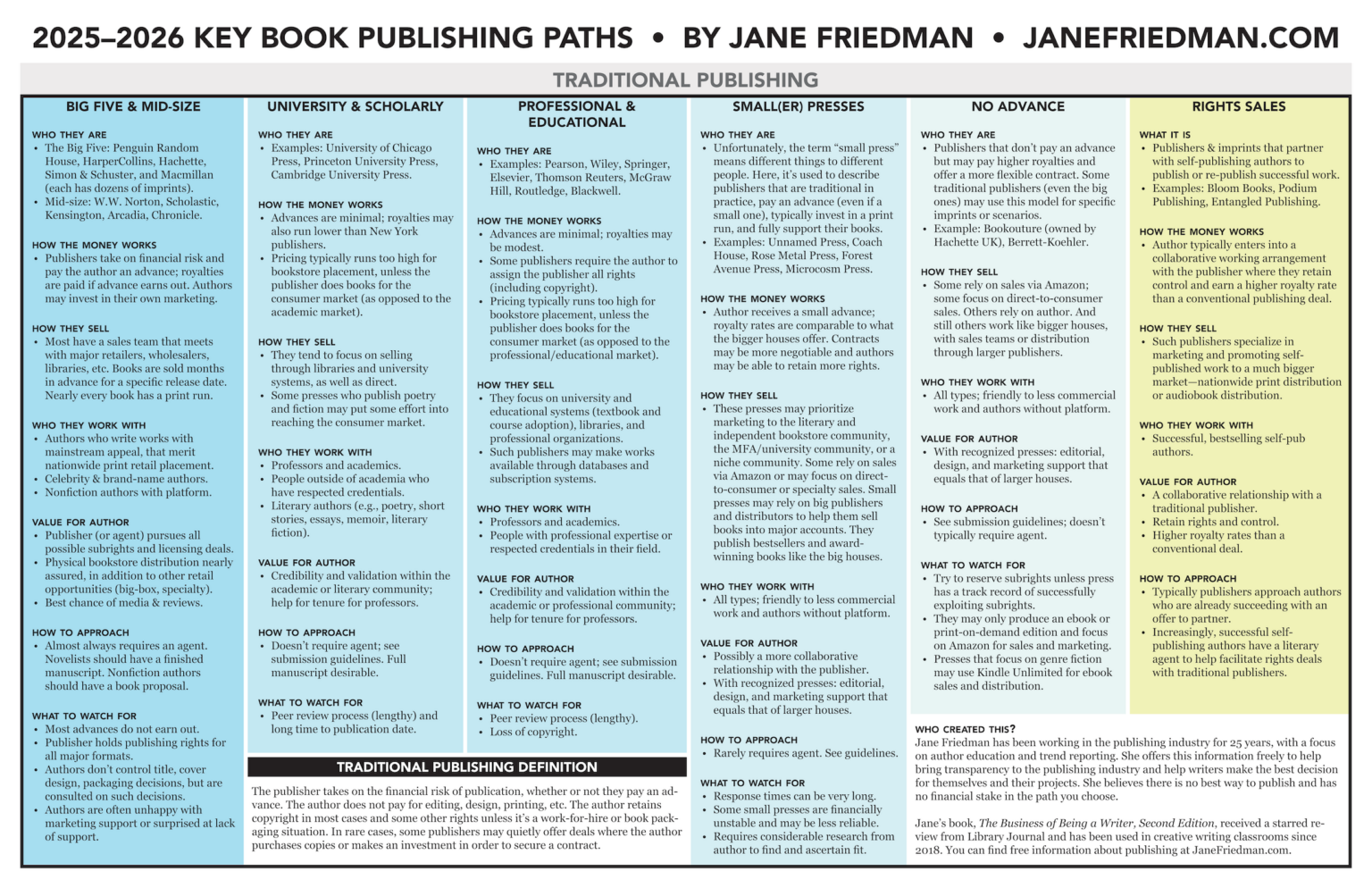
Key Book Publishing Paths - Jane Friedman
A selection of publishers arranged by size
Big 5: Macmillan, Hachette, HarperCollins, Penguin RandomHouse, Simon&Schuster
Major or Mid-tier: Chronicle, Scholastic, Sourcebooks, Amazon Publishing, Norton, Workman, Bloomsbury, Kensington, Houghton Mifflin Harcourt, Tyndale, WIley
Small or Indie: Quirk, Graywolf, TinHouse, Catapult, Lee & Low, Grove Atlantic
Micro: Et Alia, Yard Dog, Chicago Review, Sley House
Academic and tribal: Chickasaw Press, Universities of Arkansas, Texas, Oklahoma
Big 5 Presses
Who Are the Big Six Five? - Absolute Write admin
Graph of Big Five & Imprints - author Ali Almossawi
The Big 5 & their imprints - 9th Street
Over the Past 25 Years, the Big Publishers Got Bigger—and Fewer - Publishers Weekly
Midsize Presses
Midsize Publishing Takes a Mix of Whimsy, Risk, Luck, and Vision - Publishers Weekly
Small & Micropress Indies
Please note: For clarity's sake, I’m using "indie" to refer to small presses, and "self-publishing" to refer to authors who have published on their own. Midsize presses are also sometimes considered to be indies. Link titles have been altered to reflect my terminology.
Small and Independent Publishers - Jane Friedman
Small Presses - Poets & Writers
Indie Author vs Self-Published Author - author Marcy Pilkington
Should I Go With an Indie Publisher for my E-Book? - agent Rachelle Gardner
Why Publishers Fail (Precautionary tales about start up ventures) - Absolute Write
Ten Things to Know If You Publish Without An Agent - agent Janet Reid